
- 164 Posts
- 99 Comments


 6·14 days ago
I’m not sure. As long as it keeps working, I’ll probably keep using it until a viable alternative appears. I use my laptop more than my phone, so I don’t actually need passwords on my phone as often.
This one hurts… as I use this as my password manager on mobile :{



 101·1 month ago
Looks like a number of patches are landing in Ubuntu to address this: https://bugs.launchpad.net/ubuntu/+source/cups/+bug/2082335
Update: CUPS Remote Code Execution Vulnerability Fix Available





This is a great summary. Thanks!
It looks like you are running XFCE instead of GNOME (the normal Ubuntu desktop). I’m not sure how that happened… but you an always just install another desktop.
For instance, you can try to make sure you have the
ubuntu-desktoporubuntu-desktop-minimalmetapackage installed:sudo apt install ubuntu-desktop-minimalAfter that, the login manager should allow you to select the Ubuntu session rather than the XFCE one.
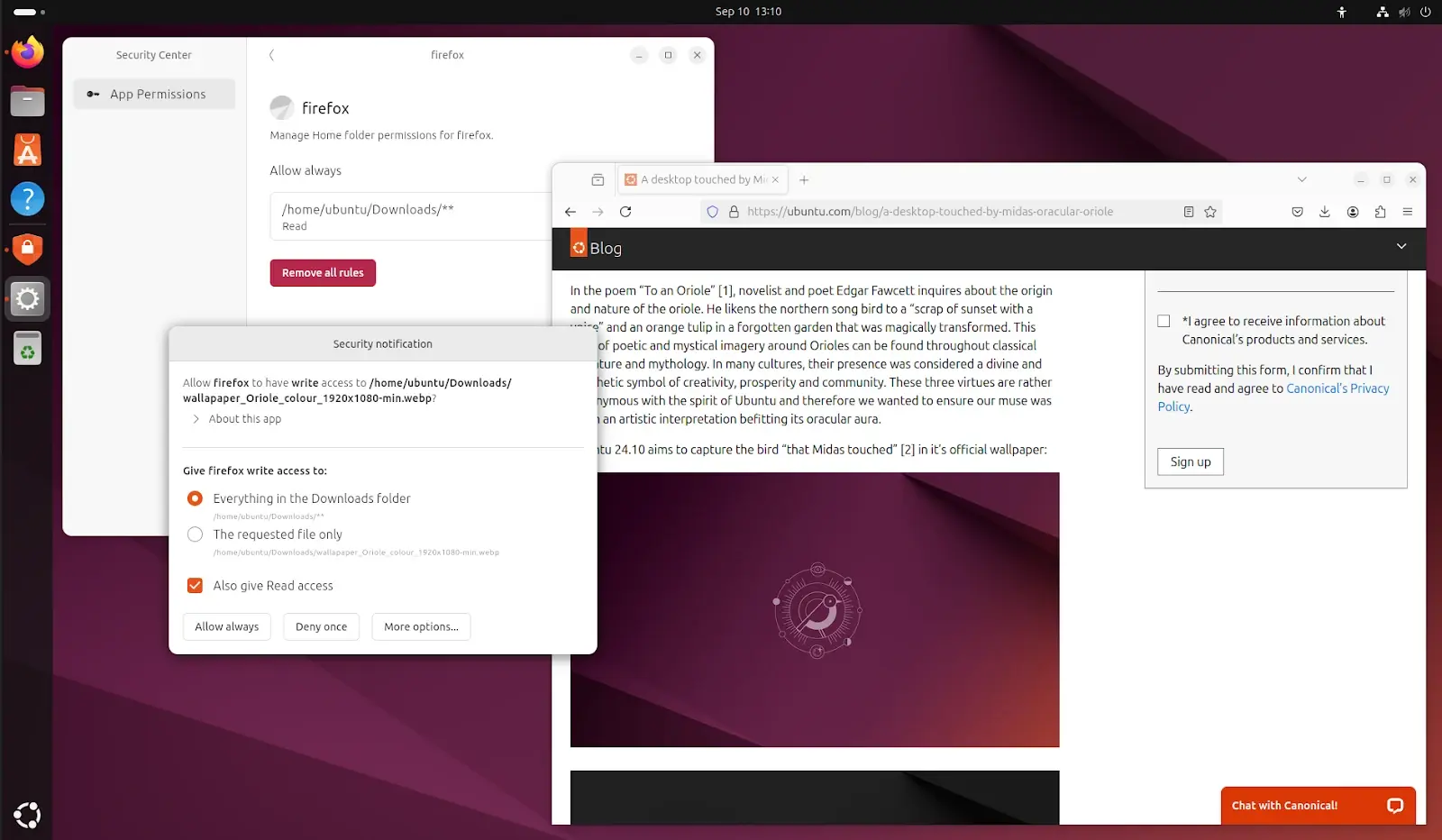
Yes, based on the diagrams on their blog, it looks like this only impacts Snaps.
From the Discourse Blog:
The Linux desktop provides XDG Desktop Portals as a standardised way for applications to access resources that are outside of the sandbox. Applications that have been updated to use XDG Desktop Portals will continue to use them. Prompting is not intended to replace XDG Desktop Portals but to complement them by providing the desktop an alternative way to ask the user for permission. Either when an application has not been updated to use XDG Desktop Portals, or when it makes access requests not covered by XDG Desktop Portals.
Since prompting works at the syscall level, it does not require an application’s awareness or cooperation to work and extends the set of applications that can be run inside of a sandbox, allowing for a safer desktop. It is designed to enable desktop applications to take full advantage of snap packaging that might otherwise require classic confinement.
So this looks like it complements and not replaces the XDG Desktop Portals, especially for applications that have not implemented the Portals. It allows you to still run those applications in confinement while providing some more granular access controls.
 4·2 months ago
I used to use VLC for music, but these days I use Symphony to play local files on my phone. VLC tended to struggle when scanning or indexing large folders (which it did all the time…), while Symphony is a bit better at that. That said, I still use VLC for video and for casting things from my DLNA server (VLC supports Chromecast).
For ebooks, I’ve used Librera FD and that has been mostly OK. I’ll checkout the two you mentioned though. Thanks!

I think you meant Pop!_OS (is developed by System76). TuxedoOS is developed by Tuxedo Computers, which is a European Linux focused hardware company.
That said, the point stands… there are hardware companies making Linux supported devices.

I’ve been using Weechat-Android to connect to my self-hosted Weechat for over a decade. This is one of the killer mobile apps that keeps me on Android and I love it.
I also have a couple instances of thelounge that people use on mobile via the PWA (progressive web app).

I think the WINE project was maintaining a fork of Mono that was used to support running certain Windows applications:
So in addition to translating traditional WIN32 system calls, WINE also supports .NET applications, which a number of Windows programs require.
Coincidentally, I received a firmware (EFI) update from Dell today via LVFS. Really nice that it works so smoothly on native Linux (no more manually downloading firmware to USB drives, or relying on Windows).
 40·3 months ago
The reasons for this shift in budget away from funding Free Software and the NGI initiative seems to be an allocation of more funds for AI, leaving internet infrastructure by the wayside. Meanwhile, the EC has thus far declined to comment to share its official reasoning for striking this funding from its budget.
Sigh. It appears that they are chasing after the latest “shiny” thing instead of investing in existing infrastructure. Not surprising, but disappointing.
+1 For xournal++. That is what I usually use for annotating slides and drawing with my wacom tablet.
I agree that the amount of work for many students can get quite out of hand and to be honest when I first started teaching, I was pretty guilty of having very work intensive courses.
That said, over the years, I’ve worked to streamline my courses to only have what I believe to be absolutely critical to learning and have added a lot of scaffolding and automated tests (for immediate results). In general, I try to have no busy work and make sure everything assignment is meaningful (as much as it can be anyway).
Additionally, because I understand that sometimes life happens, I have built-in facilities for automate extensions for assignments and even have a system for dropping certain homeworks.
This not to say that there isn’t work in my classes… it’s just that the work is intended to be relevant and reasonable, which most students seem to agree with these days.
I think students should be expected to work less over a longer period of time.
I think this would be a great idea. Or rather, I think it would be great to allow students to learn at different rates… some may want to go faster, some may want or need to go slower.
I think the modern course-based education system is often too rigid and not flexible enough to adequately accommodate the needs of students with different experience levels, resources, or constraints. Something like a Montessori model would be a lot better IMHO.
First off, 10 is an integer square root. Of 100.
Right, what I was trying to say is that 10 itself is not a perfect square. You cannot take the square root of 10 and get an integer (ie. 1, 4, 9, 16, 25, etc.).
I was told by multiple English teachers (including the head of the department) that I was a math student and should never attempt to write because I saw through the regurgitation assignments, didn’t agree with teacher assessments of what Dickens “was trying to do” and had zero interest in confirming their biases.
I think that is unfortunate and probably inappropriate. I try to avoid classifying students as particular types and generally try to encourage them whenever possible to pursue whatever their interests are (even if I disagree or don’t have the same interest myself).
College coursework on the whole is a waste of time reinventing wheels. I don’t need to spend a couple of weeks working up to “Hello, world!” in C and as such left CS as a major my first quarter at uni.
There is a reason for reinventing wheels; it is to understand why they are round and why they are so effective. To build the future, it helps to understand the past.
That said, perhaps the course was too slow for you, which is understandable… I frequently hear that about various classes (including ones I’ve taught).
But teachers do this shit every day, year after year, and we blindly say they’re doing important work even as they discourage people from finding their path and voice, because god forbid a 16-year-old challenges someone in their 50s.
Again, I think you’ve had an unfortunate experience and I think it’s a good thing to challenge your teachers. I certainly did when I was a student and I appreciate it now when students do that with me. I recognize that I am not perfect nor do I know everything. I make mistakes and can be wrong.
I wish you had a more supportive environment in secondary school and I have a better understanding of your perspective. Thanks for the dialogue.
 11·3 months ago
Sure, some people acquire the capability through repetition. But all that matters in the end is if you are capable or not.
I guess the question is how do you develop that capability if you are cheating or using a tool to do things for you? If I use GrubHub to order food or pay someone else to cook for me, does it make sense to say I can cook? After all, I am capable of acquiring cooked food even though I didn’t actually do any of the work nor do I understand how to well, actually make food.
The how is relevant if you are trying to actually learn and develop skills, rather than simply getting something done.
No, the point is to get an irrelevant piece of paper that in the end doesn’t actually indicate a persons capabilities.
Perhaps the piece of paper doesn’t actually indicate a person’s capabilities in part because enough students cheat to the point where getting a degree is meaningless. I do not object to that assessment.
Look, I’m not arguing that schooling is perfect. It’s not. Far from it. All I am saying is that if your goal is to actually learn and grow in skill, development, and understanding, then there is no shortcut. You have to do the work.
Sure. If you do enough basic math, you start to see things like how 2/8 can be simplified to 1/4 or you recognize that 10 is not a perfect square root or how you could reorder some operations to make things easier (sorry, examples from my kids). Little things like that where you don’t even think about it… it becomes second nature to you and that makes you a lot faster because you are not worrying about those basic ideas or mechanics. Instead, you can think about more complicated things such as which formulas to apply or the process to compute something.
As another example, since I teach computer science, a lot of novice students struggle with basic programming language syntax… How exactly do you declare a variable? What order do things go? How does a for loop work? Do you need a semicolon or parentheses, etc. If you do enough programming, however, these things become second nature and you stop thinking about it. You just seemily, intuitively, know these things and do them naturally without thinking, even though when you first started, it was really complicated and daunting and you probably spent a lot of time constructing a single line of code.
Once you develop a foundation however, you don’t need to worry about these low-level things. Instead you worry about high-level issues such as how to organize larger pieces of code into functions or how to I utilize different paradigums, etc.
This is why a basketball player, for instance, will shoot thousands of shots in practice or why a piano player will play a piece over and over for many hours. It’s so they don’t have to think about the low-level mechanics. It becomes muscle memory and it’s just natural to them.
I hope that makes sense.
Old School Runescape.